The Problem
Voxco had an existing Word Import feature—but it was a failure. The tool couldn't reliably maintain Word document structures when converting them to the survey editor, because each client used wildly different Word formatting conventions. Clients ended up spending hours pre-formatting their Word docs just to achieve acceptable accuracy—defeating the purpose of having an import tool in the first place. Yet the need for an automatic Word-to-survey pipeline never went away: survey designers spend roughly 80% of their time on the survey creation phase, manually recreating content that already exists in static documents. This represented a massive efficiency gap—and the emergence of LLMs made it possible to solve it. The opportunity was clear: leverage AI to make the import process intelligent and accurate while maintaining full transparency so designers could audit AI-generated results and provide feedback to help the system learn and improve over time.
The Approach
Benchmark research
I benchmarked 8 leading survey platforms—Qualtrics, SurveyMonkey, Forsta, Typeform, Google Forms, and others—mapping their import capabilities and AI-assisted parsing to understand where Voxco could differentiate.
Key market gap identified
Structured import (Forsta, Qualtrics) handled Word/Excel with varying AI type detection but required rigid formatting and often forced users to regenerate multiple times. No platform let users describe file structure upfront to guide parsing or preview results before committing to the editor.
My strategic proposal
Create AI-powered file import with pre-parsing structure description to boost first-pass accuracy, preview-before-commit to eliminate blind imports, and seamless drop into Survey Builder editor.
The Solution
I designed an AI-powered import flow that transforms static documents into structured, logic-ready surveys—eliminating hours of manual data entry while giving researchers full control over the output.
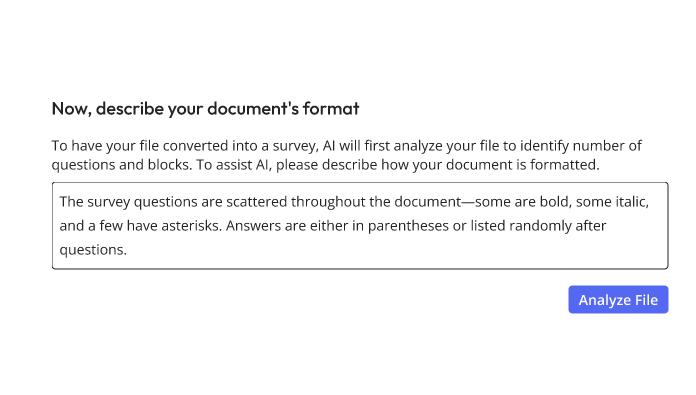
Structure Description + Guided Parsing
Users upload Word/PDF questionnaires and describe structure upfront ("Q1-Q10 single choice, Q11-Q15 multi-select (4 options)"). AI parses guided by this input instead of guessing blindly. This meets high first-pass accuracy + user control requirements by leveraging researcher domain knowledge to eliminate guesswork and dramatically reduce regeneration loops.

Preview‑Before‑Commit Workflow
Complete parsed survey appears in dedicated preview screen where users review all questions/options before deciding: ✅ Generate → Import or 🔄 Adjust description → Instant re-parse (no re-upload). This satisfies preview before commitment + transparency by eliminating "import roulette" — users see exactly what AI produced before it hits the editor canvas.

Confidence Markers & Indicators
Low-accuracy questions receive visual confidence flags while every AI-parsed question shows persistent indicator (disappears only after edit/accept). This delivers transparency by making AI decision-making immediately visible and actionable — researchers instantly know which questions need review.

Seamless Canvas Integration
Finalized survey drops directly into existing Survey Builder canvas with inline type override for misclassifications (preserving parsed options). This fulfills seamless editor integration by eliminating context switching — AI output becomes native Survey Builder content with zero learning curve.
Outcomes
Validation Results
Internal usability testing with research specialist Daniel Boulanger validated the core value: "When it works, it works very well." He predicted a paradigm shift — "Within a year, people won't manually enter questionnaires anymore" — positioning AI Import as the new standard starting point where users generate the base via AI, then add logic and adjustments. This confirmed the feature eliminates manual entry friction for both new and existing users.
Impact
For typical market research studies, building a 20–40 question survey from scratch used to take an experienced survey designer 3–6 hours of scripting and testing. With the AI Survey Import, teams now start from a finalized Word questionnaire and let the system parse and structure it automatically, cutting that work down to under an hour end‑to‑end. Upload and parsing happen in seconds to a couple of minutes, in line with other AI import tools that advertise turning Word docs into live surveys "in seconds/minutes instead of hours." The remaining time is spent on review and fine‑tuning rather than retyping, effectively shifting effort from mechanical data entry to higher‑value judgment about question quality and logic.
Senior Learning
AI should augment human expertise, not replace it. By allowing researchers to describe their file structure upfront, we leveraged their domain knowledge to dramatically improve AI accuracy—turning a potential "AI hallucination" problem into a collaborative intelligence solution. This project also taught me the importance of "trust calibration" in AI interfaces. Users need enough transparency (confidence markers, preview) to trust the system, but not so much detail that they feel overwhelmed or lose agency. Finding that balance—where AI does the heavy lifting but humans remain in full control—became the north star for the entire feature design.